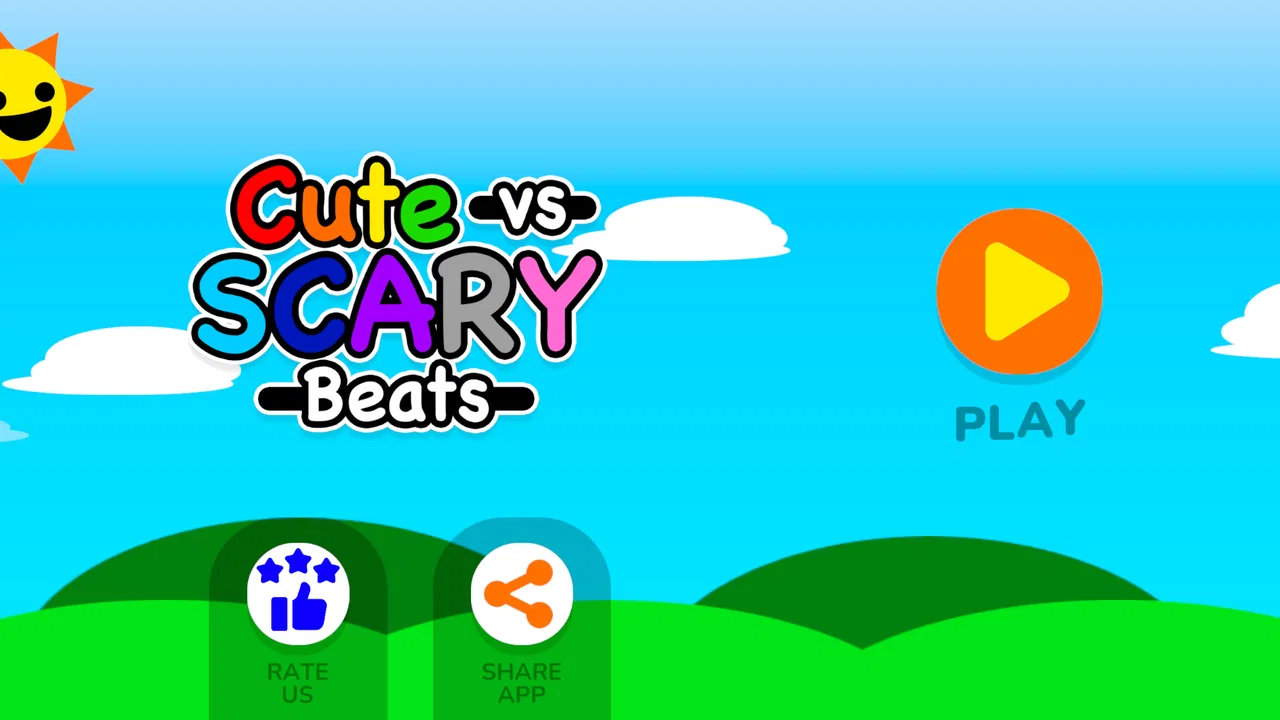
Sprunki Cute vs Scary Beats
- 3.6
- Rating
- 5.00M
- Installs
- Free
- Price

 Analysis by App-foxy
I spent time with Sprunki Cute vs Scary Beats as a casual music game, and my first impression was that it works best when I treat it like a small creative toy rather than a full music-production studio. The central appeal is simple: I can arrange playful beat elements, listen to the result immediately, and then shift the mood toward something darker through its horror-themed option. That contrast gives the game a clearer identity than a standard tap-to-score rhythm title.
It is published by SLN Games and sits in the music section, with a free download and a Teen content rating. The game has built a sizeable audience, with over five million installs and an average score of 3.7 from around twenty-eight thousand ratings. Those figures suggest a game that is easy to discover and broadly appealing, although the rating also tells me to keep expectations sensible. This is a quick, accessible beat-making experience, not a replacement for a dedicated digital audio workstation.
How the current version feels to play
The current release is version 2.7, and it feels designed around immediate experimentation. I do not need to understand musical notation before trying it. The most comfortable approach is to begin with a basic combination, listen for the repeating pattern, and then change one element at a time. That makes the game approachable for someone who simply wants to make a fun loop during a break, while still leaving room for players who enjoy testing combinations carefully.
You May Also Like

 Blood Strike: 2.5 Anniversary
Blood Strike’s Loadouts Turn Every Drop Into a Tactical Gamble
A close look at Blood Strike’s custom loadouts: how fast access to signature weapons reshapes its battle royale rhythm, rewards preparation, and narrows the gap between fights.

 Pandora - Music & Podcasts
Pandora’s Music Is Easy to Start, but Harder to Recover
Pandora’s strength is its low-effort path from a seed to a station. Its weak spot is how much confidence it asks you to place in connection, setup, and quiet recovery.

 8 Ball Pool
 Is Built on Rivalries, Rematches, and Routine
A close look at the rivalries, rematches, shared routines, and unanswered safety questions that turn a quick pool match into a persistent mobile community.

 Samsung Music
’s Quiet Strength Is Playing What You Already Own
Its reach comes less from spectacle than from dependable access to a personal library. That simplicity is both the app’s strongest retention engine and its ceiling.

 AccuWeather: Weather Radar
AccuWeather Review: A Quick, Clear Forecast for Everyday Decisions
For everyday plans, the best forecast is the one you can understand quickly. AccuWeather makes rain timing, radar, and local conditions easy to act on, with a few trade-offs.

 Hill Climb Racing
Why Hill Climb Racing Still Turns Crashes Into One More Run
A tiny car, a bumpy hill and one more upgrade: Hill Climb Racing keeps resurfacing because its simple chaos makes every near-miss feel personal.
More From Our News Desk



The cute-versus-scary idea is more than a visual theme. It gives each session a mood choice. I can start with a lighter, more playful sound and then explore the horror mode when I want the same kind of activity to feel more unusual. That switch is particularly effective when I am playing with friends or showing the game to someone who would normally ignore a simple beat app. The novelty comes from hearing how a familiar creative setup changes when the atmosphere turns spooky.
I found the game easiest to enjoy in short sessions. It suits the moment when I have a few minutes and want something interactive but not demanding. There is no need to prepare a playlist, learn a complicated control scheme, or commit to a long level. I can experiment, listen, decide whether the mix works for me, and stop. That convenience is one of its strongest qualities.
The free price also lowers the barrier to trying it. For a curious player, there is little reason not to test the basic idea and decide personally whether the sound combinations are engaging. At the same time, free casual games often depend on how much patience a player has for repetition, and this one is no exception. If I expect a large catalog of deep musical challenges, I may find the experience narrower than expected.
Building a beat without treating it like homework
My preferred workflow is to establish a steady foundation first, then add more distinctive sounds. When I place too many unusual elements at once, it becomes harder to tell which part is improving the loop and which part is making it cluttered. Removing a sound can be just as useful as adding one. That is an important habit here because the game rewards listening, not simply filling every available space.
A useful trick is to make two versions of the same idea. I begin with a cheerful arrangement, remember the combination that gives it the clearest pulse, and then use that as a reference when exploring the scary side. This makes the contrast easier to notice. Instead of judging the horror mode as an isolated novelty, I can compare the mood change directly and decide whether the darker treatment adds character or merely makes the mix feel busier.
Another practical tip is to play with headphones at a moderate volume. The game’s purpose is musical, so small background parts can be easy to miss through a phone speaker, especially in a noisy room. Headphones make it easier to hear whether a new layer supports the rhythm or competes with it. I would not describe this as a requirement, but it improves the trial-and-error process considerably.
I also recommend saving mental notes about combinations that work instead of changing everything after each attempt. A simple sequence of small adjustments gives me a better sense of cause and effect. This is where the game has more value than its short store summary suggests: it can quietly teach basic arrangement instincts, such as leaving space, balancing repetition, and using a contrasting sound for emphasis.
What the horror mode adds to the experience
The horror option is the feature that gives the game its most memorable hook. It is not just a second name for the same activity; it changes the atmosphere I associate with the beat-making process. I enjoy using it after creating a lighter loop because the shift feels more noticeable than starting in a dark mood from the beginning.
That said, players should approach the horror element as a playful spooky twist rather than a full horror game. The main activity remains creating beats. Someone looking for suspense, exploration, combat, or a story-driven scare will be looking in the wrong place. The mode is better understood as a change in musical flavor and presentation.
For younger players, the Teen rating is worth taking seriously. The game’s appeal may look cute at first, but the scary direction means it is not something I would automatically hand to every child. Adults deciding whether it suits a family device should consider the player’s comfort with spooky imagery and sound. The rating is a useful reminder that the two sides of the title are not equally gentle.
How the game has developed and what that means for players
The game was released on November 5, 2024, and the current version is 2.7. That progression matters because it shows the project has moved beyond its initial launch build. I see the version number as evidence of ongoing product evolution, but I would not treat it as proof of any particular feature unless I can experience that feature directly. The important current fact for a new player is that the app is not frozen at its first release.
For existing users, a later version can make returning worthwhile even when the core concept remains familiar. The best way to approach an update like this is not to expect an entirely different game, but to check whether the present build feels smoother, more complete, or more interesting in its balance between cute and scary presentation. Players who already enjoyed the original concept are the most likely to appreciate incremental refinement.
New users benefit in a different way. They can begin with the current version rather than trying to understand how the game felt at launch. That makes the first session more relevant to the experience they will actually have. I would still judge it by its present creative loop: make a combination, listen, adjust, and explore the mood change. The version history is useful context, but it should not replace hands-on evaluation.
The minimum operating-system requirement is Android 7.0, which makes the game accessible to people using older Android devices rather than limiting it to recent hardware. That is helpful for a casual title, because the audience may include players who do not upgrade phones frequently. Even so, device age can affect comfort in practical ways such as screen responsiveness, audio output, and general smoothness. I would keep expectations realistic on older phones.
One of the more interesting effects of the game’s evolution is that it now has a clearer reason to return than a one-time novelty. The cute and scary sides create a natural comparison loop: I can revisit an arrangement, change its tone, and see whether the result feels more effective. That does not guarantee unlimited replay value, but it gives the game a second angle that a single-theme beat toy would not have.
Who will get the most from it
I think this is a good fit for casual players who enjoy music experimentation but do not want the technical burden of a professional audio app. It is also suitable for people who like discovering combinations, comparing moods, and sharing a quick creation with a friend nearby. The free entry point makes it easy to test, while the straightforward concept means I can understand the basic appeal quickly.
It can also work as a gentle introduction to arranging sound. I would not use it as a formal lesson, but a beginner can learn useful instincts by noticing how a steady beat changes when another layer enters. The cute-versus-scary contrast adds a practical exercise: keep the underlying idea similar, then judge how atmosphere changes the listener’s impression.
On the other hand, I would skip it if my priority is precise editing, recording, exporting, detailed tempo control, or serious composition. A conventional music-production app is a better choice for those needs. Likewise, rhythm-game fans who want timed notes, score chasing, and increasingly difficult stages may find the creative arrangement focus less exciting than a traditional rhythm title.
It is also not ideal for someone who dislikes repetition. The pleasure comes from trying combinations and hearing differences, so a player who wants constant new objectives may run out of reasons to continue sooner than a curious experimenter. The game’s strength is its relaxed loop, and that same relaxed design can feel limited when I want a stronger sense of progression.
A realistic everyday use case
Imagine having ten minutes before leaving for work or school. I can open the game, create a light beat while waiting, and then test the horror mode before closing it. I do not need to remember a complex campaign or arrange a long session. If I am with a friend, we can take turns choosing the next sound and argue about whether the cute or scary version works better.
That scenario captures the game’s best use. It fills a small pocket of free time with something more creative than passive scrolling, but it does not demand the attention of a full game. I would not plan an entire evening around it unless I particularly enjoy musical tinkering. Its value is strongest as a compact activity that can be picked up and put down without preparation.
Where the experience still feels limited
The biggest limitation is depth. The game gives me a fun framework for making beats, but it does not replace the control and flexibility of a dedicated music tool. I cannot approach it expecting the same level of precision that comes with arranging tracks manually. The simplified design is what makes it welcoming, yet it also sets a ceiling on how far an experienced musician can push the result.
Replay value depends heavily on personal curiosity. I can get several enjoyable sessions from comparing combinations, especially when I deliberately build a clean version before making it darker. However, once I understand the main interaction, the experience may become familiar. Players who need a constant stream of goals should consider that trade-off before making it their main music game.
The rating of 3.7 from around twenty-eight thousand ratings reinforces my balanced view. Many players clearly find enough appeal to try and keep using it, while the score is not so high that I would assume it satisfies everyone. I read that as a reason to focus on fit: the game is more likely to please someone who enjoys casual beat creation than someone seeking a polished, competitive rhythm system.
The Teen classification is another boundary rather than a flaw. The spooky direction may be exactly what attracts some players, but it can make the app unsuitable for younger children or anyone who wants purely cheerful music play. I appreciate that the title presents both sides openly, but I would still check the tone personally before recommending it to a sensitive player.
What I would watch as the game continues
For future updates, I would pay attention to whether the developers deepen the contrast between the two moods without making the controls harder to understand. More meaningful reasons to revisit existing arrangements would help the game retain players after the first burst of curiosity. I would also value improvements that preserve quick sessions rather than turning the app into a complicated production suite.
Existing users should watch how version 2.7 develops in practice rather than assuming the number alone guarantees a major transformation. The useful questions are simple: does the current build make experimentation feel smoother, does the scary side remain distinct from the cute side, and does returning to an old beat still reveal something new? Those are better indicators of progress than a version label by itself.
New players can make the most of the current release by approaching it with a small experiment in mind. Start with a restrained beat, listen before adding anything else, and then recreate the idea through the horror mode. That method exposes the game’s central strength quickly and prevents the first session from turning into random tapping.
My final recommendation is positive, with clear limits. I would suggest Sprunki Cute vs Scary Beats to a friend who wants a free, approachable music game with a playful spooky angle. I would describe it as a creative break, not a complete music workstation or a demanding rhythm challenge. Its best quality is the way a simple beat can feel different when the mood changes. If that idea sounds fun, the current version is worth trying. If I needed professional control, deep progression, or conventional score-based gameplay, I would choose a different app instead.
FAQs for Sprunki Cute vs Scary Beats
01What is Sprunki Cute vs Scary Beats about?
Sprunki Cute vs Scary Beats is a rhythm-based game where players navigate through a whimsical world filled with adorable and spooky creatures. The game challenges you to keep up with the beats while switching between cute and scary themes, providing a unique and engaging musical experience.
02Is Sprunki Cute vs Scary Beats free to play?
Sprunki Cute vs Scary Beats offers a free-to-play model, allowing players to download and enjoy the basic features without cost. However, there are in-app purchases available that provide additional content, such as exclusive levels, characters, and customization options to enhance the gameplay experience.
03What are the system requirements for Sprunki Cute vs Scary Beats?
To enjoy Sprunki Cute vs Scary Beats, Android users need a device running version 5.0 or higher, while iOS users require iOS 11.0 or later. Adequate storage space and a stable internet connection are also recommended for optimal performance and to access all features smoothly.
04Does Sprunki Cute vs Scary Beats offer multiplayer modes?
Currently, Sprunki Cute vs Scary Beats focuses on a single-player experience, allowing players to immerse themselves in the rhythm without distraction. While there is no multiplayer mode yet, the developers have hinted at potential updates that may introduce competitive or cooperative gameplay in the future.
05How frequently is Sprunki Cute vs Scary Beats updated?
The developers of Sprunki Cute vs Scary Beats are committed to providing regular updates to enhance the game. These updates often include new levels, characters, and bug fixes. Players can expect new content and improvements every few months, ensuring the game remains fresh and engaging.
Pros
- Engaging rhythm-based gameplay.
- Colorful and vibrant graphics.
- Intuitive controls enhance fun.
- Variety of cute and scary themes.
- Challenging levels keep players hooked.
Cons
- Occasional lag on older devices.
- Limited free content available.
- Ads can interrupt gameplay.
- Requires internet for updates.
- In-app purchases can be costly.

Sprunki Cute vs Scary Beats
Gallery